Saturday 28th March 2026 – 2:00pm
Chawton Village
Chawton Village
Jane Austen’s brother, Edward Knight inherited Chawton House in 1809 and offered Chawton cottage as a home to his mother and two sisters. It was here that Jane lived the last eight years of her life and was able to devote much of her time to writing. Her genius flourished and she wrote, revised and published her most famous novels: Sense and Sensibility, Pride and Prejudice, Mansfield Park, Emma, Northanger Abbey and Persuasion.
Today the cottage welcomes visitors to step back in time and follow in Jane’s footsteps exploring the rooms where she lived and wrote. The unparalleled collection of treasures include Jane’s jewellery, personal letters, first editions and her writing table.
Drawing Room – Jane Austen was a keen pianist although the family piano and music scores were sold when the family moved to Bath in 1801. However, Chawton cottage allowed her once again the pleasure of a piano and she played every morning before breakfast. Sheet music was expensive, so it was common for women of her class to borrow scores and transpose them by hand into music copybooks. Jane’s copybook includes the title ‘Juvenile Songs and Lessons’ whilst underneath, in her handwriting, is the ironic aside, ‘for young beginners who don’t know enough to practice’. The Clementi square piano is of a slightly later date than the one the Austen family purchased on moving to Chawton, but it is likely to have been of a similar style and quality. It was in this room that Jane read Pride and Prejudice aloud to a neighbour on the day she received her first copy.
Dining Room– Jane wrote at a little, walnut, tripod table, placed by the window for light. Her nephew, James Edward Austen-Leigh wrote:
‘She was careful that her occupation should not be suspected by servants, or visitors, or any persons beyond her own family party. She wrote upon small sheets of paper which could easily be put away or covered with a piece of blotting paper.’
The top of the table is thought to be original, but the legs are possibly older. After Jane’s death the table was passed to the footman, William Littleworth, on his retirement. In 1957 the table was given to the Jane Austen Society and returned to Chawton cottage.

Bedroom – A small modest room shared by Jane and Cassandra. The tent bed is a replica of the one shared by the sisters at their childhood home, Steventon Rectory. The simple sampler was probably the first that Cassandra made as a young girl.
Jane Austen & Textiles
Jane Austen was as skilled with a needle as she was with a pen. In an 1870 biography of his aunt, James Edward Austen-Leigh described her as being, ‘successful with everything that she attempted with her fingers.’ Whether she was plotting her novels or working at her needle, she was observed to be happier in her domestic rather than her professional employment. Her niece, Caroline Austen, refers to her aunt’s skill with a needle, writing, ‘She was very fond of work, and she was a great adept at overcast and satin stitch, the particular delight of the day.’ Jane herself writes to Cassandra in September 1796, ‘we are very busy making Edward’s shirts and I am proud to say that I am the neatest worker of the party’. This plain-work, was commonly undertaken in the home by mothers, sisters and daughters. Catherine Morland, heroine of Northanger Abbey, who is much better at talking about clothes than making or embroidering them, disappoints her mother when she allows the gaiety of Bath to distract her from making her brother’s cravats.
For Jane Austen, needlework was also a sociable activity , making clothes or embroidering and crafting gifts for family, friends and the wider community, surrounded by female companions. Embroidery for middle-class women in the Georgian period was considered a suitable leisure pursuit and proved they were fit to run a domestic household. It is no surprise that Mrs. Goddard’s parlour in Emma is ‘hung around with fancy work,’ the perfect advertisement for the suitability of a schoolteacher turning out young ladies.
Jane’s surviving letters show she had a keen interest in fabrics, fashion and style, although she was constrained by her limited budget as a single woman on the fringes of gentility. She frequently writes of the price of fabrics, garments and trimmings bought as ‘great bargains.’ She struck deals with haberdashers, unpicked and repurposed clothes or embellished outmoded garments. Although flattered when her friends asked for the ‘pattern’ of a cap she and her sister had stitched, she was ‘not so well pleased’ with Cassandra ‘giving it to them’. All girls and women of the time were expected to be able to make their own caps, even if they could afford to buy them. They were particularly useful as a way of reducing hair maintenance and the need for curling. Emma Woodhouse was irritated and most probably jealous, when she is forced to see ‘exhibitions of new caps and new work-bags’ made by the brilliantly accomplished Jane Fairfax in Emma.
Jane sometimes used needlework to help define her characters. The self-centered Lady Bertram of Mansfield Park is is summed up as ‘a woman who spent her days in sitting nicely dressed on a sofa, doing some long piece of needlework, of little use and no beauty, thinking more of her pug than her children.’ Her daughter, the wayward Julia Bertram, is shown to be capable of working a footstool, but the result is ‘too ill done for the drawing-room’. We are also shown the petty, vindictive nature of Lady Catherine de Bourgh in Pride and Prejudice, who advises Elizabeth Bennet and her friend Charlotte Collins to do their work ‘differently’.
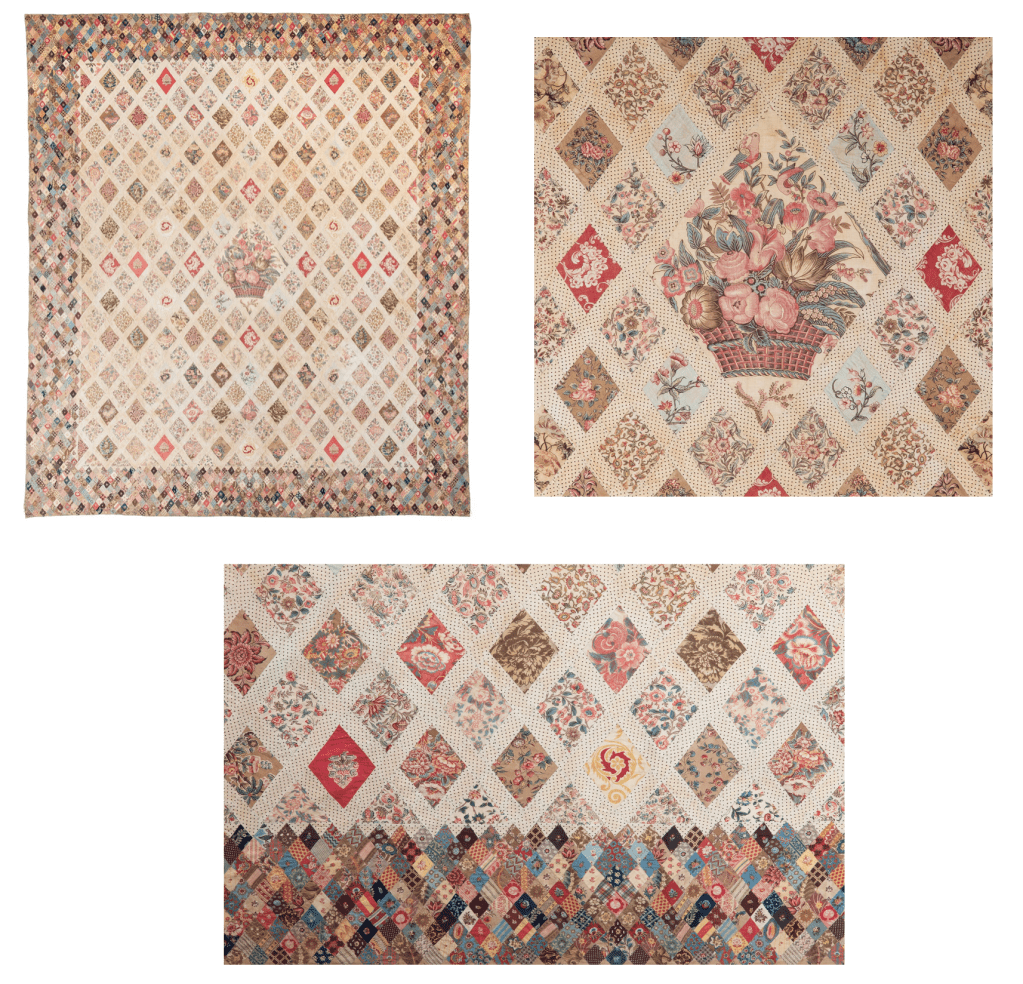
At least three known examples of Jane Austen’s needlework survive; a stunning medallion quilt, a monogrammed handkerchief and a needlework case. All three pieces are held by the Jane Austen House in Chawton.
Linen and Cotton Patchwork Coverlet
Measuring approximately 262cm x 232cm, this patchwork coverlet was made by Jane Austen, her sister Cassandra and their mother. It is not known exactly when the coverlet was made but in May 1811 Jane wrote to Cassandra, ‘Have you remembered to collect pieces (sic) for the patchwork – we are at a standstill’. At the time Cassandra was staying with their brother Edward at his estate in Kent and there would have been many fabric offcuts from the family dressmaker. There are at least 64 fabrics in the patchwork top, which is backed with cotton but has no internal wadding. The intricate design comprises a central panel of diamonds with four-fold symmetry and an outer border of over 2500 tiny diamonds also placed symmetrically with top and bottom and left and right sides matching. It was made using the English paper piecing method; the fabric is folded around paper templates and stitched together along the edges by hand before the paper is removed.
Needlecase
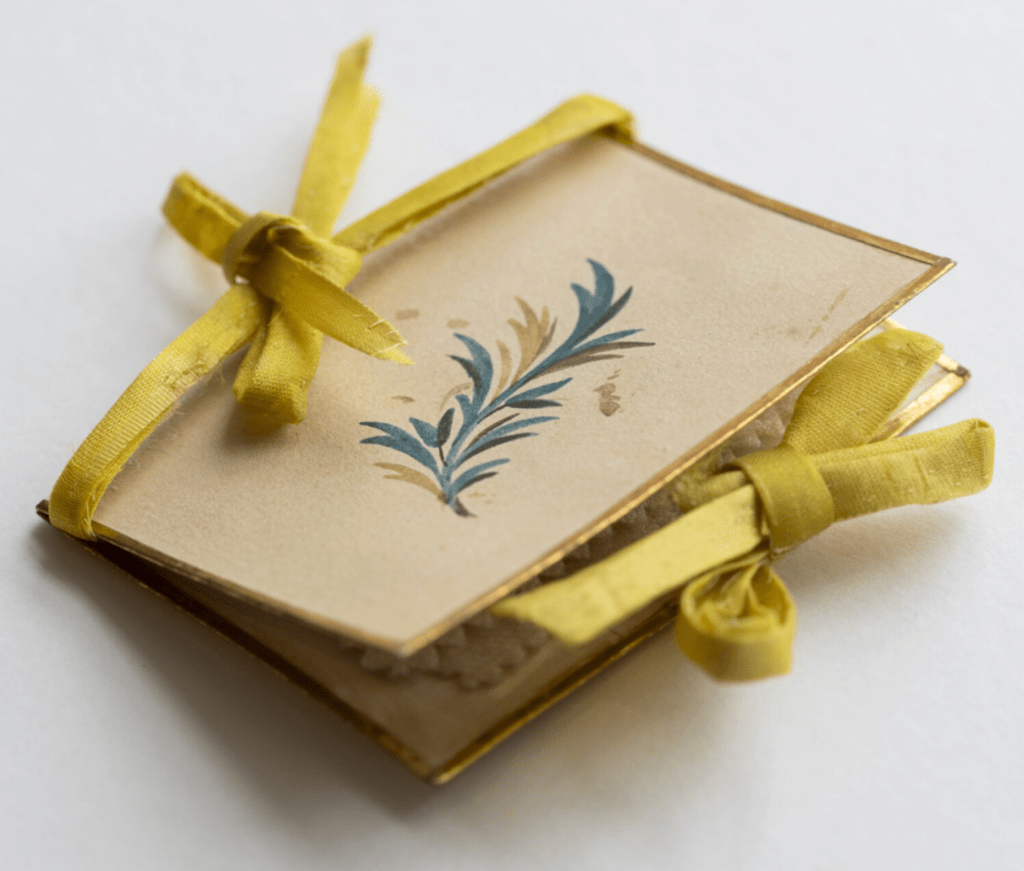
This painted card needle case, edged in gold paper with a felt insert for the needles, was a gift from Jane Austen to her niece Louisa Knight. The original tissue wrapper is inscribed ‘with Aunt Jane’s Love’ in Jane Austen’s handwriting.
Cassandra’s Handkerchief
Much of the sewing of the period was referred to as ‘women’s work’. This everyday sewing was done for necessity, making and adapting clothes, nightwear and bedding. Other needlework crafts such as embroidery were considered as accomplishments to be attained and admired.
However, Jane Austen appears to believe in a balance of accomplishments; Mr. Darcy in Pride and Prejudice is critical of the so-called ‘accomplished’ woman who is capable of ‘netting a purse or covering a skreen’ but can do little else of note. He demands ‘something more substantial’ in a woman: a mind cultivated by ‘extensive reading’.
This hand embroidered handkerchief, worked in satin stitch, with the initials C.A. in one corner was stitched by Jane Austen for her sister Cassandra.

Useful Information
Books
Jane Austen at Home – Lucy Worsley
The Real Jane Austen: A Life in Small Things – Paula Byrne
A Jane Austen Year: Celebrating 250 years of Jane Austen – Jane Austen House
Jane Austen: A Life – Claire Tomalin
Jane Austen Embroidery – Jennie Batchelor & Alison Larkin
Needlework Patterns in the Era of Jane Austen – Jody Gayle
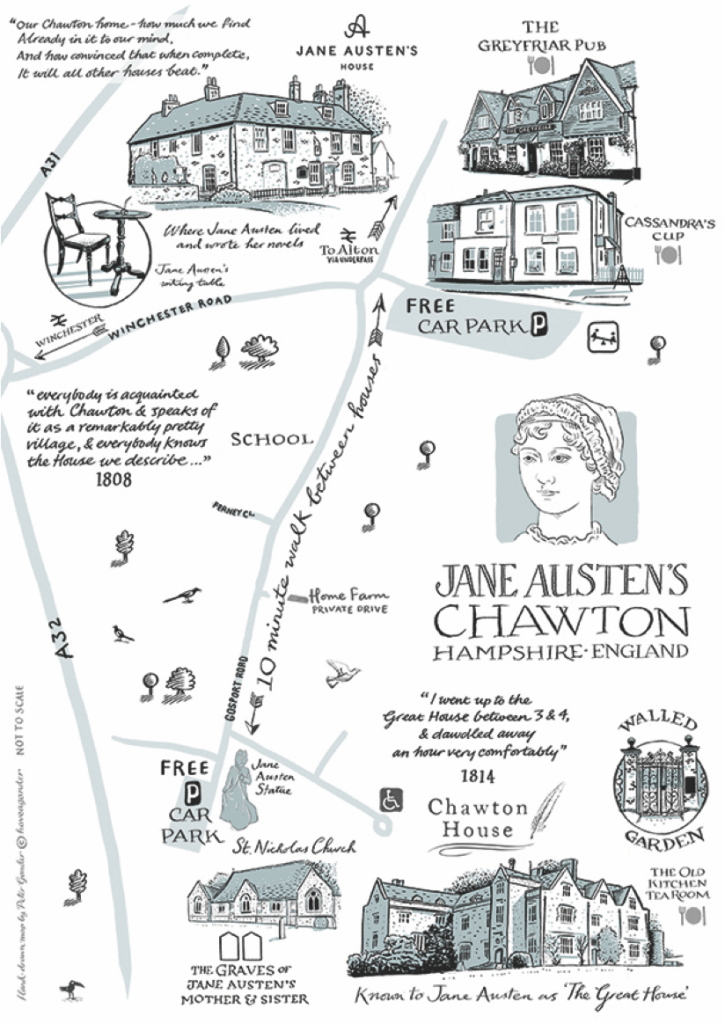
If the weather is fine, you may like to walk through Chawton village. Approximately 10 minutes from the cottage is St Nicolas Church where the graves of Jane’s mother and sister are located as well as a statue of Jane Austen. Further up the graveled drive is Chawton House, home of Jane’s brother Edward Knight. The house and gardens are open to the public but require a separate ticket and unfortunately there will not be time to visit, although you should be able to see the house from the drive.
 Stitch UK Retreats